If you’re on acreage around Upper Caboolture, Wamuran, or anywhere off the town sewer, your home treats its own wastewater on-site. And when it comes time to install or replace that system, the choice usually comes down to two options: a traditional septic tank or an aerated wastewater treatment system (AWTS).
For most modern acreage properties in this region, an AWTS is the better option. On the heavy clay soils common around Caboolture, the mandatory site and soil evaluation report often rules a standard septic absorption trench out anyway, which is why AWTS has become the default recommendation out here. Here’s the honest comparison so you understand why.
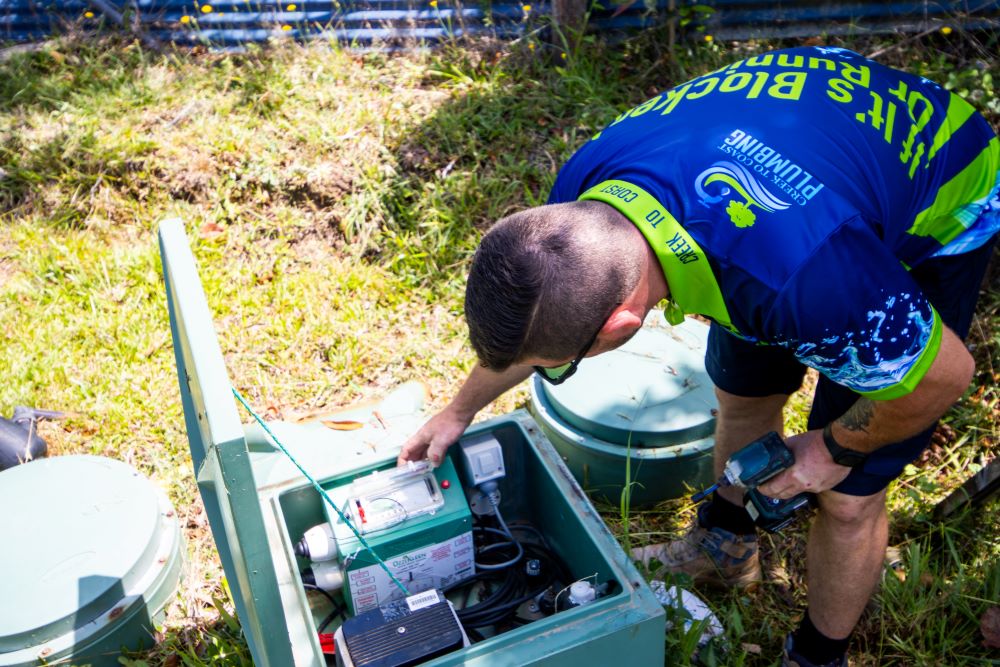
How a traditional septic tank works
A septic tank is the older, simpler technology. Wastewater flows into a tank where solids settle to the bottom and bacteria break them down anaerobically, without oxygen. The partially treated liquid then flows out to a trench or absorption field where it soaks into the ground.
It works, but the treatment is basic. The effluent leaving a septic tank is only partially treated, which is why it has to be disposed of below ground in a trench, because it isn’t clean enough to do anything else with. The system depends entirely on your soil being able to absorb that effluent, which is a real problem on the heavy clay soils common around Caboolture.
How an AWTS works
An aerated wastewater treatment system takes the same wastewater through several stages and actively pumps air through it. That oxygen feeds aerobic bacteria, which break the waste down far more thoroughly. The treated water is then disinfected, usually with chlorine, before it leaves the system.
The result is a much higher quality effluent. It’s clean enough to be reused above ground through subsurface or low-pressure irrigation, watering your gardens and lawn instead of just soaking away in a trench. The treatment stages typically run:
- Primary chamber: solids settle and begin breaking down, as in a septic tank.
- Aeration chamber: air is pumped in, feeding the aerobic bacteria that do the heavy lifting.
- Clarifying chamber: remaining solids settle out of the now well-treated water.
- Disinfection: the treated water is disinfected before discharge to irrigation.
Why AWTS is the better option for Caboolture acreage
- It works on clay soil. A septic trench needs soil that drains. Much of the acreage around Caboolture sits on heavy clay that doesn’t absorb effluent well, so septic trenches struggle, get waterlogged and can surface. An AWTS irrigates treated water across a larger area and doesn’t rely on the ground swallowing partially treated effluent.
- Council increasingly requires it. For many new installs and replacements, Moreton Bay Regional Council will only approve a secondary-treatment system like an AWTS, particularly where soil conditions or block size make a septic trench unsuitable. In a lot of cases the choice has already been made for you.
- You reuse the water. Instead of losing your wastewater into a trench, an AWTS turns it into irrigation for your gardens, genuinely useful on a large block, especially through a dry spell.
- Better for the environment and your neighbours. Properly treated, disinfected effluent is far less of a contamination risk to groundwater, dams and waterways than partially treated septic discharge.
- Smaller land footprint. Because the water is treated to a higher standard, the disposal area can be smaller than a full septic absorption trench, useful where usable land is limited.

The trade-off: AWTS needs servicing
We won’t pretend an AWTS is maintenance-free, because it isn’t. An AWTS has an air pump and moving parts, and under Queensland regulations it must be serviced quarterly by a licensed technician. That’s a legal requirement, not a recommendation, and the council needs to see your service records.
A septic tank has no pump and needs far less attention, usually just a periodic pump-out of the solids every few years. So if you’re comparing purely on maintenance, the septic tank is simpler. But that simplicity comes at the cost of poorer treatment, trench problems on clay, and council approval issues. For most acreage owners around here, the quarterly AWTS service is a fair price for a system that actually works on the block and keeps you compliant.
What does it cost?
As a rough guide, an AWTS install is a bigger investment than a basic septic system once you account for the treatment unit, the pump and the irrigation field, and a site that needs a mound or pump-to-sewer arrangement sits higher again. But these are only a guide. The real figure depends on your soil, your block, the system size for your household, the disposal area and access, and every property is different.
There are too many variables to quote a flat price, so we assess your property and council requirements first, then give you an accurate quote with no surprises. Call 1300 793 962 or contact us to book a wastewater system assessment.
Frequently asked questions
Can I just replace my old septic tank with another septic tank?
Not always. When you replace a failed system, council assesses it as a new installation against current standards. On many Caboolture-area blocks, particularly clay soils or smaller acreage, they’ll require a secondary-treatment system like an AWTS rather than approving a like-for-like septic trench. We check the council requirements for your specific property before recommending anything.
How often does an AWTS need servicing?
Quarterly, four times a year, by a licensed service technician. This is a legal requirement in Queensland, and council can ask to see your service records. The service checks the pump, the air supply, the disinfection and the overall function. We can take care of the quarterly servicing for you so you stay compliant without having to track it.
What happens if I don’t service my AWTS?
Two problems. First, the system stops treating the water properly, because the aerobic bacteria need the air pump running, so a neglected AWTS discharges poorly treated effluent, which is a health and environmental risk. Second, you’re in breach of your council approval conditions, which can lead to compliance action. Regular servicing avoids both and keeps the system running for its full life.
Can the treated water really be used on my garden?
Yes, and that’s one of the main advantages of an AWTS. The treated, disinfected water is discharged through subsurface or low-pressure irrigation across a designated area of your block, watering lawn and gardens. It’s not for drinking or for edible crops, and the irrigation area has to meet council setback rules, but it puts your wastewater to use instead of losing it down a trench.
How long does an AWTS last?
The tank itself can last decades. The pump and mechanical components wear over time and get checked and replaced as part of regular servicing, which is exactly why the quarterly service matters. A well-maintained AWTS keeps running reliably for many years, while a neglected one fails early.

Our Services
Get A Quote
Contact us today for a free, no-obligation quote on your plumbing needs.